I thought I had moved for the last time but I may get on the merry-go-round again.
Freelance work has dwindled to where the emphasis is on free and I have begun looking for work in earnest, even considering jobs outside of the Tampa area. I like living here and I like freelancing here but work here has evaporated.
Several of the outlets for which I have done regular work have gone belly up and I have not found new ones to replace them. I haven't given up on my video biography business but it has not produced a reliable income.
Fortunately, threat of destitution is far off but I'd rather avoid making it a contest.
I also thought I had left television news behind as a full-time occupation. When I moved to Florida in late 2004, it was more important to choose where I lived than what I did for a living. That was easier when there were more available options for work.
While I have long embraced the new media -- I built my first web site in 1997 and encoded my first online video the next year -- that have become the buzzwords of traditional news outlets, TV news as a business is getting younger and cheaper. I am not and I wonder if there is still a market for someone with my skills and experience (read: age).
Maybe. Instead of mailing videotapes, many job ads now ask for online links to examples of your work, such as those on the video page at JohnMcQuiston.com. This not only saves money and time, my web site's stat counter eliminates the mystery of whether anyone sees my work.
It can also compress the time someone will respond. It used to be that you'd send a tape First Class. That would take 2-4 days. The the tape would become part of "the stack" that you hoped a station's news director would find time to watch. If you ever heard anything, it could take weeks.
Now a news director can open an e-mail on his BlackBerry, click on a link, watch your work and call you that day. I know this because twice now news directors have called me within hours of my sending an e-mail to them. I was not prepared for that and I hope I didn't blow my chances at what sounded like decent opportunities stumbling through my shock.
Another news director asked to see more of my news anchoring. I dug a newscast excerpt out of my computer, encoded and uploaded it to my site, created a page for it and sent him the link. I offered to mail a DVD if he prefers.
Here's what he'll see:
Yes, that newscast is five years old. There are clips of my traffic reporting from as recently as June so anyone can see that I still have some hair and can still perform on camera.
If you know anyone who needs a standout storyteller who has reported and anchored every kind of story from hard news to fluffy features, sports and even traffic, please point them to me.
Showing posts with label Media. Show all posts
Showing posts with label Media. Show all posts
Friday, September 03, 2010


Tuesday, August 17, 2010
Arkansas Radio Reporter Fired for Florida Hat
This will seem like homerism, since I live in Florida and, in fact, own a Florida Gators hat. But this is ridiculous.
Hence the ridicule to follow.
An Arkansas radio station that bills itself "Hog Sports Radio" fired one of its reporters for wearing a Florida Gators cap to a news conference with Arkansas Razorbacks football coach Bobby Petrino.
Renee Gork is a University of Florida alumna. She says she grapped the Gators hat without thinking because it was raining outside. It wasn't a stunt, a protest, or an attempt to provoke Petrino.
No matter how rushed she was or how wet your hair might have gotten, this was extraordinarily poor judgment on Gork's part. First of all, any Florida-themed apparel gets buried at the bottom of the closet the second I move into my Arkansas abode. Second, wearing any university-logoed cap to a college football news conference, friend or foe, is entirely unprofessional.
However, her punishment should have ended with the embarrassment she must have felt when Petrino finished a reply to a question from Gork by saying, "and that will be the last question I answer with that hat on."
But fired? C'mon. This seems backwards even for Arkansas.
"This radio station is Hog Sports Radio," KAKS general manager Dan Storrs told The Associated Press. "We are very biased. We support the Razorbacks 100 percent."
And you take your support for a college football team far too seriously.
I get it. You make your living kissing up to the U of A. It doesn't help that cause if one of your employees wears an enemy's hat to cover a Razorbacks event. But there's loyalty and there's idiocy. This goes beyond even that. Storrs had turned what should have been a reprimand and a local chuckle into a national embarassment.
For him. As if people don't already think of Arkansans as intolerant rubes, this just reinforces it. Unbelievable.
Hence the ridicule to follow.
An Arkansas radio station that bills itself "Hog Sports Radio" fired one of its reporters for wearing a Florida Gators cap to a news conference with Arkansas Razorbacks football coach Bobby Petrino.
Renee Gork is a University of Florida alumna. She says she grapped the Gators hat without thinking because it was raining outside. It wasn't a stunt, a protest, or an attempt to provoke Petrino.
No matter how rushed she was or how wet your hair might have gotten, this was extraordinarily poor judgment on Gork's part. First of all, any Florida-themed apparel gets buried at the bottom of the closet the second I move into my Arkansas abode. Second, wearing any university-logoed cap to a college football news conference, friend or foe, is entirely unprofessional.
However, her punishment should have ended with the embarrassment she must have felt when Petrino finished a reply to a question from Gork by saying, "and that will be the last question I answer with that hat on."
But fired? C'mon. This seems backwards even for Arkansas.
"This radio station is Hog Sports Radio," KAKS general manager Dan Storrs told The Associated Press. "We are very biased. We support the Razorbacks 100 percent."
And you take your support for a college football team far too seriously.
I get it. You make your living kissing up to the U of A. It doesn't help that cause if one of your employees wears an enemy's hat to cover a Razorbacks event. But there's loyalty and there's idiocy. This goes beyond even that. Storrs had turned what should have been a reprimand and a local chuckle into a national embarassment.
For him. As if people don't already think of Arkansans as intolerant rubes, this just reinforces it. Unbelievable.
Tampa TV Reporters Fired For YouTube Video

Fake newscasts and blooper reels are as old as TV news. Before YouTube, they were the products of harmless fun that only a few people would see. You edited them on tape, gathered the intended audience into an edit booth and showed off the results in person. Tapes were inconvenient to copy, at least compared to copying-and-pasting a bit of text, so you were relatively assured that your inside joke would stay inside the group with whom you shared it.
Now, editing happens on computers, and you get a video file that is all too easy to upload to the Universe. Once there, you lose any control over who sees it and shares it. If it goes "viral," it can cause a fatal illness to your job, if not your entire career.
That's why I feel bad for those who lost their jobs. They thought they were doing something funny for a friend. It's the brain surgeon who thought he or she had to share the video on Facebook and YouTube whose career ought to be kaput.
Firing seems excesssive punishment. The station's GM told the Times that the video could risk the station's credibility, which I understand to a point. But I saw the clip before it was removed from YouTube and if the only people still watching TV news are ones who couldn't immediately tell that this was a fake story, I'm not sure that the business has much credibility left, anyway.
Meanwhile, I remain grateful that the bulk of my broadcast career happened in the ante-YouTube era. My on-air mishaps haunt me enough in memories. I'd hate to think how I'd feel if they were conveniently available for anyone to view.
Saturday, July 24, 2010
How VJs Are Changing TV News?
The money savings that one-person TV news crews promise is convincing more stations to use them. Instead of a reporter and a photographer, a one-man-band shoots and reports the story him or herself. These one-man-bands (OMBs) are variously called video journalists (or VJs) and multimedia journalists (MMJs), depending on whose pig the lipstick is being applied.
Former CBS News reporter Deborah Potter writes on newslab.org that one-man-bands are changing not only how news is gathered but how it looks on the air.
Potter cites an unpublished dissertation by Kutztown University's Mary Angela Bock which reports that the challenge of shooting and reporting one's own work often forces OMBs to go for the easiest stories to turn, rather than those most interesting to viewers. "Because they work alone, VJs will be more apt to look for quick and easy access to story elements," Potter quotes Bock as writing.
Another problem with OMB work, Potter notes, is the physical demands of the job. Even common doorways can prove formidable obstacles to the lonely journalist larded with equipment.
Seriously. Those are the two salient points in the article, which seemed a veiled argument against OMBs. I hope that the 500 pages that Bock says her treatise spans includes more compelling information because the items cited do not detail accurately how increased use of solo news crews affects the news you see on TV.
First, OMBs are not the only ones who go for the low hanging fruit under the ever-increasing pressure of producing news for broadcast at 11 and for the web right now. It's not because they work alone that they pursue easy elements; it's because they have deadlines that come sooner than they once did. So do two-person crews and they're just as guilty of the "one-stop shopping" syndrome.
You can make a better argument claiming that former photographers new to reporting either seek or are assigned features because they lack either the confidence in themselves or the trust of management to tackle meatier stories.
And as someone who has shot plenty of my own stories (the homepage of my website, JohnMcQuiston.com, features a story I shot myself), I have never found a doorway that was a serious impediment. The physical strain argument overlooks the fact that the major station groups — including Gannett, Hearst and Scripps Howard — that have adopted OMBs to some degree have all bought small and relatively cheap cameras for them to use.
Their physical load is less than that of a traditional photographer.
Potter notes that Bock "reports that the National Union of Journalists in England is starting to hear health complaints–such as exhaustion or back problems–from VJs who have been on the job a few years."
I hope Bock also reports what percentage of VJs make such complaints, how many traditional news photographers make similar complaints, and whether the National Union of Journalists opposes the use of VJs. That would added needed perspective.
If you want to argue against OMBs, here it is: When one person does the jobs that used to belong to two, it's not going to be done as well. Looking for shots is a different pursuit than digging for facts and when you have to do both, they're going to suffer for it.
That's it. The rest is like the mumbo-jumbo of the Atkins diet when the bottom line is that you lose weight because you consume fewer calories. Conversely, the advantage of using OMBs is that they cost about half of two-person crews. Anything more is just the aforementioned porcine lipstick.
The most obvious thing you see with OMB work right now is that it's new (or so old as to seem new) to many of the people doing it. You have life-long photographers suddenly trying to write and read narration for a news story. Reporters get two days of training with their new camera and out they go to turn a story with it.
Of course it looks like left-handed writing by right-handed people.
This will change as aspiring reporters learn that shooting their stories is not just something they will have to do in college or in their first job out of school. Stations won't be trying to teach people to write with their other hand. They'll arrive already ambidextrous.
Will they produce work as much or as good as two-person crews do now? Almost certainly not. Would it be ideal to have teams of two collaborating on a story? Almost certainly yes.
But OMBs didn't cause the Shirley Sherrod fiasco. And they're not going away. An article about how to do better work under the circumstances would do much more good than one apparently wishing the circumstances where different.
Former CBS News reporter Deborah Potter writes on newslab.org that one-man-bands are changing not only how news is gathered but how it looks on the air.
Potter cites an unpublished dissertation by Kutztown University's Mary Angela Bock which reports that the challenge of shooting and reporting one's own work often forces OMBs to go for the easiest stories to turn, rather than those most interesting to viewers. "Because they work alone, VJs will be more apt to look for quick and easy access to story elements," Potter quotes Bock as writing.
Another problem with OMB work, Potter notes, is the physical demands of the job. Even common doorways can prove formidable obstacles to the lonely journalist larded with equipment.
Seriously. Those are the two salient points in the article, which seemed a veiled argument against OMBs. I hope that the 500 pages that Bock says her treatise spans includes more compelling information because the items cited do not detail accurately how increased use of solo news crews affects the news you see on TV.
First, OMBs are not the only ones who go for the low hanging fruit under the ever-increasing pressure of producing news for broadcast at 11 and for the web right now. It's not because they work alone that they pursue easy elements; it's because they have deadlines that come sooner than they once did. So do two-person crews and they're just as guilty of the "one-stop shopping" syndrome.
You can make a better argument claiming that former photographers new to reporting either seek or are assigned features because they lack either the confidence in themselves or the trust of management to tackle meatier stories.
And as someone who has shot plenty of my own stories (the homepage of my website, JohnMcQuiston.com, features a story I shot myself), I have never found a doorway that was a serious impediment. The physical strain argument overlooks the fact that the major station groups — including Gannett, Hearst and Scripps Howard — that have adopted OMBs to some degree have all bought small and relatively cheap cameras for them to use.
Their physical load is less than that of a traditional photographer.
Potter notes that Bock "reports that the National Union of Journalists in England is starting to hear health complaints–such as exhaustion or back problems–from VJs who have been on the job a few years."
I hope Bock also reports what percentage of VJs make such complaints, how many traditional news photographers make similar complaints, and whether the National Union of Journalists opposes the use of VJs. That would added needed perspective.
If you want to argue against OMBs, here it is: When one person does the jobs that used to belong to two, it's not going to be done as well. Looking for shots is a different pursuit than digging for facts and when you have to do both, they're going to suffer for it.
That's it. The rest is like the mumbo-jumbo of the Atkins diet when the bottom line is that you lose weight because you consume fewer calories. Conversely, the advantage of using OMBs is that they cost about half of two-person crews. Anything more is just the aforementioned porcine lipstick.
The most obvious thing you see with OMB work right now is that it's new (or so old as to seem new) to many of the people doing it. You have life-long photographers suddenly trying to write and read narration for a news story. Reporters get two days of training with their new camera and out they go to turn a story with it.
Of course it looks like left-handed writing by right-handed people.
This will change as aspiring reporters learn that shooting their stories is not just something they will have to do in college or in their first job out of school. Stations won't be trying to teach people to write with their other hand. They'll arrive already ambidextrous.
Will they produce work as much or as good as two-person crews do now? Almost certainly not. Would it be ideal to have teams of two collaborating on a story? Almost certainly yes.
But OMBs didn't cause the Shirley Sherrod fiasco. And they're not going away. An article about how to do better work under the circumstances would do much more good than one apparently wishing the circumstances where different.
Monday, June 28, 2010
College Newspaper and TV Newsrooms Merge
The seismic shift in news media has begun to reshape journalism schools. The University of Kansas has merged the newsrooms of its student newspaper and television station. The University Daily Kansan will move into a newsroom where KUJH-TV studio is located.
A cynic will say that now the TV people won't have to go as far to get story ideas from the paper.
KU says in a news release that the merger will "provide journalism students with greater opportunities to tell their stories more dynamically across print, broadcast, online and new and emerging media."
In other words, the TV people won't be going to get stories from the paper because they'll be the ones writing stories for the paper. And the newspaper reporters will be producing stories for TV.
"The students will benefit from learning in a true multimedia environment," said Terry Bryant, lecturer in journalism and media lab manager. "The variety of skills they master will serve them well when they become professional journalists after graduating from KU."
If the students think this is theoretical, heretical or just radical, they should take a look at WFLA-TV and the Tampa Tribune, Media General-owned outlets which operate from a single newsroom with reporters and photographers shared between the two media.
WFLA-TV photographers have been given Nikon DSLR still cameras with which they shoot photos for the Tribune. More than occasionally, photographers will write and narrate their own TV stories. Newspaper reporters turn stories for TV. TV reporters write for the paper.
Convergence is not just a crazy idea in some bean counter's head somewhere. The debate about whether this should happen is moot. More and more large market TV stations are hiring what they call multi-media journalists — those who shoot their own stories and tap out a text version for the station's web site while they're at it.
If that's the real world, it's good to see journalism schools begin to prepare students for what they're in for when they get there.
A cynic will say that now the TV people won't have to go as far to get story ideas from the paper.
KU says in a news release that the merger will "provide journalism students with greater opportunities to tell their stories more dynamically across print, broadcast, online and new and emerging media."
In other words, the TV people won't be going to get stories from the paper because they'll be the ones writing stories for the paper. And the newspaper reporters will be producing stories for TV.
"The students will benefit from learning in a true multimedia environment," said Terry Bryant, lecturer in journalism and media lab manager. "The variety of skills they master will serve them well when they become professional journalists after graduating from KU."
If the students think this is theoretical, heretical or just radical, they should take a look at WFLA-TV and the Tampa Tribune, Media General-owned outlets which operate from a single newsroom with reporters and photographers shared between the two media.
WFLA-TV photographers have been given Nikon DSLR still cameras with which they shoot photos for the Tribune. More than occasionally, photographers will write and narrate their own TV stories. Newspaper reporters turn stories for TV. TV reporters write for the paper.
Convergence is not just a crazy idea in some bean counter's head somewhere. The debate about whether this should happen is moot. More and more large market TV stations are hiring what they call multi-media journalists — those who shoot their own stories and tap out a text version for the station's web site while they're at it.
If that's the real world, it's good to see journalism schools begin to prepare students for what they're in for when they get there.
Friday, June 25, 2010
Be Ready To Evacuate Or Beware Citizen Journalists?
Recently I wrote about people's ever-increasing need to be wary of news stories they read. In the race to be first, sometimes accuracy gets lost in the rush.
And that's just among mainstream media. Many more so-called news sources exist, whose authors who lack the knowledge or interest in backing up their stories with pesky little things like facts.
Here's a great example.
Today a Facebook friend posted a link to an article that suggested that officials were ready to trigger plans to evacuate Tampa Bay because of the Gulf oil spill.
The article reads as if composed of a dash of fact and two cups of conjecture. It doesn't cite any officials saying that they're considering evacuating the area. Where's the story coming from? I dunno. The article does not even include a byline. I posted on my friend's page, "I wish the article cited sources. As written, it reads like speculation."
My friend had shared the link from another person. That person replied with a link to another article with a nearly identical story, as if the fact that someone copy-and-pasted the article adds credibility to its contents.
At least this version, which appears to be the original, had a byline. But the author is either a terrible writer or an awful reporter. She lets a reader infer that because "plans are in place" for an evacuation that those who could order one have their finger poised over the "go" button.
In a reply on Facebook, I wrote, "Is there a plan in place? I sincerely hope so! There is a plan in place for evacuation from a hurricane too. But there is no evidence cited that those who could order an evacuation have even considered it."
The article appears on examiner.com, which pays writers on a pay-per-click basis. Whether the writer inadvertently failed to label a commentary as such or whether she deliberately distorted facts hoping the story would go viral, I don't know.
It was clear from the comments on my friend's Facebook page that more than a few people were willing to take the story at face value, believing what "they" say without question who "they" are or even if they exist.
As I concluded my Facebook reply, "Please, please, be skeptical of what they say. They are usually just making stuff up."
And that's just among mainstream media. Many more so-called news sources exist, whose authors who lack the knowledge or interest in backing up their stories with pesky little things like facts.
Here's a great example.
Today a Facebook friend posted a link to an article that suggested that officials were ready to trigger plans to evacuate Tampa Bay because of the Gulf oil spill.
The article reads as if composed of a dash of fact and two cups of conjecture. It doesn't cite any officials saying that they're considering evacuating the area. Where's the story coming from? I dunno. The article does not even include a byline. I posted on my friend's page, "I wish the article cited sources. As written, it reads like speculation."
My friend had shared the link from another person. That person replied with a link to another article with a nearly identical story, as if the fact that someone copy-and-pasted the article adds credibility to its contents.
At least this version, which appears to be the original, had a byline. But the author is either a terrible writer or an awful reporter. She lets a reader infer that because "plans are in place" for an evacuation that those who could order one have their finger poised over the "go" button.
In a reply on Facebook, I wrote, "Is there a plan in place? I sincerely hope so! There is a plan in place for evacuation from a hurricane too. But there is no evidence cited that those who could order an evacuation have even considered it."
The article appears on examiner.com, which pays writers on a pay-per-click basis. Whether the writer inadvertently failed to label a commentary as such or whether she deliberately distorted facts hoping the story would go viral, I don't know.
It was clear from the comments on my friend's Facebook page that more than a few people were willing to take the story at face value, believing what "they" say without question who "they" are or even if they exist.
As I concluded my Facebook reply, "Please, please, be skeptical of what they say. They are usually just making stuff up."
Monday, June 07, 2010
Suspect Suicide Caught on Video. Do You Air It?
Media aren't the gatekeepers of information they once were.
The story about a porn star suspected of murder hurling himself off a cliff as Los Angeles police tried to subdue him is a great example. Though police failed to grab Stephen Clancy Hill before he fell to his death, he was captured on video.
Do you air it?
It's not pleasant to look at but it's not nearly as graphic as the Budd Dwyer gun-in-mouth suicide televised live in 1987. Airing the video might counter accusations of police brutality. Hill was black and the LAPD is not known for just treatment of minorities. Rodney King, anyone?
It has the makings of a great debate.
One rendered totally moot by YouTube.
As stations and now newspapers and radio stations with their video-enabled web sites gnash their teeth weighing the merits, viewers have already decided for themselves if they want to see it. Those who do have no trouble finding it online.
If you're a news director or an editor or just an idiot arguing on a message board you are debating as an exercise. Your verdict has little to do with what news consumers actually see. That itself introduces a new dynamic in the decision-making process. I wonder how it will change news outlets' thinking (A) about showing the video and (B) covering the story?
Interesting times.
The story about a porn star suspected of murder hurling himself off a cliff as Los Angeles police tried to subdue him is a great example. Though police failed to grab Stephen Clancy Hill before he fell to his death, he was captured on video.
Do you air it?
It's not pleasant to look at but it's not nearly as graphic as the Budd Dwyer gun-in-mouth suicide televised live in 1987. Airing the video might counter accusations of police brutality. Hill was black and the LAPD is not known for just treatment of minorities. Rodney King, anyone?
It has the makings of a great debate.
One rendered totally moot by YouTube.
As stations and now newspapers and radio stations with their video-enabled web sites gnash their teeth weighing the merits, viewers have already decided for themselves if they want to see it. Those who do have no trouble finding it online.
If you're a news director or an editor or just an idiot arguing on a message board you are debating as an exercise. Your verdict has little to do with what news consumers actually see. That itself introduces a new dynamic in the decision-making process. I wonder how it will change news outlets' thinking (A) about showing the video and (B) covering the story?
Interesting times.
Monday, May 24, 2010
NOT the "Female Viagra"
"When men show up at the pharmacy to pick up prescription drugs for sex problems, they have several options. Viagra. Cialis. Levitra. That hasn’t been the case for women with similar problems."
So begins a CNN story about flibanserin, a drug designed to boost a woman's libido that the FDA is considering. A story on CBS News' website calls it, "female Viagra."
The problem with these comparisons? While they're both pills and they both relate to sex, flibanserin does not treat the same kinds of sex problems that Viagra treats in men. It is not the "female Viagra."
Viagra can make a man able to have sex but it doesn't give him the desire for it. In fact, Viagra's maker, Pfizer, was forced to pull ads that intimated that the drug rejuvenated a man's sex drive. Viagra, Cialis and Levitra do nothing for libido.
It may not seem like a big deal. But it's another example of media outlets demonstrating that they don't understand the things they're reporting. This one doesn't require a lot of technical or medical knowledge to get right. You just have to pay attention.
So begins a CNN story about flibanserin, a drug designed to boost a woman's libido that the FDA is considering. A story on CBS News' website calls it, "female Viagra."
The problem with these comparisons? While they're both pills and they both relate to sex, flibanserin does not treat the same kinds of sex problems that Viagra treats in men. It is not the "female Viagra."
Viagra can make a man able to have sex but it doesn't give him the desire for it. In fact, Viagra's maker, Pfizer, was forced to pull ads that intimated that the drug rejuvenated a man's sex drive. Viagra, Cialis and Levitra do nothing for libido.
It may not seem like a big deal. But it's another example of media outlets demonstrating that they don't understand the things they're reporting. This one doesn't require a lot of technical or medical knowledge to get right. You just have to pay attention.
Friday, May 07, 2010
The Story vs. The Facts
Do media need to get the facts right or just the story?
There is a difference. If you tell me that two plus two equals five and I report that, I have reported the story correctly but I have reported the fact incorrectly.
Is that OK? Should we be happy to get the story straight, even if its information is wrong? The news director at WPXI-TV in Pittsburgh seems to think so.
Last Friday, the WPXI reported that former Pittsburgh Steelers player Santonio Holmes was escorted off a commercial flight at Pittsburgh International Airport. Turns out that Holmes was not escorted off the plane. He was merely admonished for not turning off his iPod prior to landing. He left the plane with the rest of the passengers.
The station later updated its story without clarifying that its earlier report was untrue.
"The story changed and we changed it," WPXI news director Mike Goldrick told the Pittsburgh Post-Gazette. "We didn't feel like we needed to correct it because we don't feel like it was wrong. The story we got, we reported, and when the story changed we reported it."
"The information we had at the time was right. The information changed," Goldrick said.
I guess that depends on what the definition of information is. The facts the station had at the time were wrong. The facts didn't change. Holmes was either escorted off the plane or he wasn't. Unless there were two separate flights, Holmes was not escorted off the plane earlier in the day and left it on his own later.
It happened only one way. If you reported something else, you got it wrong, no matter how accurately you reported the story you heard.
Now that the news cycle is no longer 24-hours but second-to-second, we can expect a lot of stories to change as first reports increasingly become less factual. As getting it first takes more priority over getting it right, people will become more skeptical of media reports. They'll need, like reporters once did, independent confirmation from another source before they'll believe what they see, hear or read.
When that happens, what will separate the mainstream media from ordinary bloggers?
There is a difference. If you tell me that two plus two equals five and I report that, I have reported the story correctly but I have reported the fact incorrectly.
Is that OK? Should we be happy to get the story straight, even if its information is wrong? The news director at WPXI-TV in Pittsburgh seems to think so.
Last Friday, the WPXI reported that former Pittsburgh Steelers player Santonio Holmes was escorted off a commercial flight at Pittsburgh International Airport. Turns out that Holmes was not escorted off the plane. He was merely admonished for not turning off his iPod prior to landing. He left the plane with the rest of the passengers.
The station later updated its story without clarifying that its earlier report was untrue.
"The story changed and we changed it," WPXI news director Mike Goldrick told the Pittsburgh Post-Gazette. "We didn't feel like we needed to correct it because we don't feel like it was wrong. The story we got, we reported, and when the story changed we reported it."
"The information we had at the time was right. The information changed," Goldrick said.
I guess that depends on what the definition of information is. The facts the station had at the time were wrong. The facts didn't change. Holmes was either escorted off the plane or he wasn't. Unless there were two separate flights, Holmes was not escorted off the plane earlier in the day and left it on his own later.
It happened only one way. If you reported something else, you got it wrong, no matter how accurately you reported the story you heard.
Now that the news cycle is no longer 24-hours but second-to-second, we can expect a lot of stories to change as first reports increasingly become less factual. As getting it first takes more priority over getting it right, people will become more skeptical of media reports. They'll need, like reporters once did, independent confirmation from another source before they'll believe what they see, hear or read.
When that happens, what will separate the mainstream media from ordinary bloggers?
Monday, December 07, 2009
Outsourced Sports
WPTV-TV in West Palm Beach has canned its sports staff and handed its sports coverage to a local radio station, according to the Palm Beach Post.
Axing sports departments was once the province of bottom-feeding stations throwing in the towel on a segment of the audience it was never going to reach. But West Palm's NBC affiliate is a long-time powerhouse in that market, just like WFLA in Tampa was when it decided it could get by with just one on-air sports anchor. Instead of outsourcing to a radio station, WFLA shares sports reporters with the Tampa Tribune — which, like WFLA, is owned by Media General.
WFLA does still have a sports photographer. The Post article does not explain how a radio station is going to put together video highlights and stories or how a guy whose afternoon drive radio show begins at 4 o'clock will do TV segments at 5 and 6.
Not that it matters. One reader comment to the WPTV story sums up a growing attitude toward sports among many stations: "nothing personal... but ch 5’s sports was a minute or two of headlines... my 8 yr old could do it and for $100 a week... welcome to the new economy."
The TV station probably figured that no one was watching that "minute or two of headlines" so why not put someone on who will promote his appearance on the radio all afternoon. Click here to see a clip of the radio host Even Cohen who will now tackle TV duties.
Axing sports departments was once the province of bottom-feeding stations throwing in the towel on a segment of the audience it was never going to reach. But West Palm's NBC affiliate is a long-time powerhouse in that market, just like WFLA in Tampa was when it decided it could get by with just one on-air sports anchor. Instead of outsourcing to a radio station, WFLA shares sports reporters with the Tampa Tribune — which, like WFLA, is owned by Media General.
WFLA does still have a sports photographer. The Post article does not explain how a radio station is going to put together video highlights and stories or how a guy whose afternoon drive radio show begins at 4 o'clock will do TV segments at 5 and 6.
Not that it matters. One reader comment to the WPTV story sums up a growing attitude toward sports among many stations: "nothing personal... but ch 5’s sports was a minute or two of headlines... my 8 yr old could do it and for $100 a week... welcome to the new economy."
The TV station probably figured that no one was watching that "minute or two of headlines" so why not put someone on who will promote his appearance on the radio all afternoon. Click here to see a clip of the radio host Even Cohen who will now tackle TV duties.
Tuesday, December 01, 2009
Murdoch: Media Must Get Online Readers to Pay
More than a decade after the term was coined, tradition media have not learned how to avoid becoming roadkill on the "Information Superhighway." The question facing journalism in a free market is how to make enough money from it to pay the people who produce it.
"Technology makes it cheap and easy to distribute news for anyone with Internet access," says media mogul Rupert Murdoch. "But producing journalism is expensive."
The obvious solution, he says, is to force readers of online news sites to pay for the privilege. That works for entities such as the Wall Street Journal, which Murdoch now owns, but the WSJ generates content for which readers will pay a premium. The stories you read there aren't available anywhere else.
How many other media outlets can say that? Even the WSJ, which once charged for access to all of its content, now gives a lot of it away for free. People can find most stories in too many places for any of them to be able to charge money for them.
Ads don't seem to be enough. People who are willing to let commercials interrupt their TV viewing get offended when ads pop up in front of what they're reading online. But just because ad revenue from websites don't make up for what newspapers and TV stations have lost from tradition ads doesn't mean that an ad-supported model won't work for a strictly web-based outlet.
Eventually, some enterprising reporters — in more than one sense of the word — will come together to form cooperatives that will take advantage of the cheap distribution channels now available without any of the baggage (printing presses, delivery trucks, broadcast TV towers and too many middle managers) that are sinking traditional media.
"Technology makes it cheap and easy to distribute news for anyone with Internet access," says media mogul Rupert Murdoch. "But producing journalism is expensive."
The obvious solution, he says, is to force readers of online news sites to pay for the privilege. That works for entities such as the Wall Street Journal, which Murdoch now owns, but the WSJ generates content for which readers will pay a premium. The stories you read there aren't available anywhere else.
How many other media outlets can say that? Even the WSJ, which once charged for access to all of its content, now gives a lot of it away for free. People can find most stories in too many places for any of them to be able to charge money for them.
Ads don't seem to be enough. People who are willing to let commercials interrupt their TV viewing get offended when ads pop up in front of what they're reading online. But just because ad revenue from websites don't make up for what newspapers and TV stations have lost from tradition ads doesn't mean that an ad-supported model won't work for a strictly web-based outlet.
Eventually, some enterprising reporters — in more than one sense of the word — will come together to form cooperatives that will take advantage of the cheap distribution channels now available without any of the baggage (printing presses, delivery trucks, broadcast TV towers and too many middle managers) that are sinking traditional media.
Thursday, November 26, 2009
TV News is Dead
So says a guy trying to sell it a resuscitator. "Burn down the buildings," says Michael Rosenblum on the Mark Joyella's LocalNewser blog. Rosenblum is a consultant who claims that his VJ newsroom model, in which traditional two-person reporter/cameraman crews become one-person do-it-all video journalists, will cut costs and increase content.
I have nothing to fear if the buildings burn down. Though I've spent most of my career on camera, I own cameras and am happy to do freelance jobs as a one-man-band, especially since it means I don't have to share my fee!
However, I'm struggling to understand Mr. Rosenblum's math when he claims that local stations have two-hundred newsroom employees yet put only eight cameras on the street. First, where are these local newsrooms with 200 people? Second, where are these newsrooms that have only eight cameras?
But if you market yourself as a media messiah, you need the faithful to feel the doom. Before you sell the cure, you have to sell the disease.
Not that TV news doesn't have its ills. But it's interesting that the lynch pin of Michael's solution is to get rid of the photographers — half of the people who are generating video content — when it's not too many people on the street we have but too many special projects producers, executive producers and anchors who only anchor that bloat newsroom staffs.
Michael would be cheered to learn that stations have gotten rid of sound men.
Unfortunately for Michael — and for the increasing number of TV stations that have decided that two-person crews are a luxury — operating a video camera is not equivalent to using a pencil. That is evident in the video on this page, in which Michael is nearly in silhouette thanks to a distractingly bright computer monitor in the frame and no light on the subject.
If no camera light was available, it would have taken approximately ten seconds to find a darker web page to display on the monitor and another ten to put the camera's iris on manual and open it up to brighten the subject's face so it wouldn't look like we were trying to hide his identity.
This matters because video quality affects how viewers judge the product's credibility. If you don't have 20 seconds to get the camera shot right, how can I think that you took the time to get the facts right? If your video looks amateurish, the reporting will too.
Competent camera work doesn't require a PhD but it does take more than two days of training and a week of practice to master. In a business based on video, I'd look for other fat to trim before I started cutting the source of my best pictures.
I have nothing to fear if the buildings burn down. Though I've spent most of my career on camera, I own cameras and am happy to do freelance jobs as a one-man-band, especially since it means I don't have to share my fee!
However, I'm struggling to understand Mr. Rosenblum's math when he claims that local stations have two-hundred newsroom employees yet put only eight cameras on the street. First, where are these local newsrooms with 200 people? Second, where are these newsrooms that have only eight cameras?
But if you market yourself as a media messiah, you need the faithful to feel the doom. Before you sell the cure, you have to sell the disease.
Not that TV news doesn't have its ills. But it's interesting that the lynch pin of Michael's solution is to get rid of the photographers — half of the people who are generating video content — when it's not too many people on the street we have but too many special projects producers, executive producers and anchors who only anchor that bloat newsroom staffs.
Michael would be cheered to learn that stations have gotten rid of sound men.
Unfortunately for Michael — and for the increasing number of TV stations that have decided that two-person crews are a luxury — operating a video camera is not equivalent to using a pencil. That is evident in the video on this page, in which Michael is nearly in silhouette thanks to a distractingly bright computer monitor in the frame and no light on the subject.
If no camera light was available, it would have taken approximately ten seconds to find a darker web page to display on the monitor and another ten to put the camera's iris on manual and open it up to brighten the subject's face so it wouldn't look like we were trying to hide his identity.
This matters because video quality affects how viewers judge the product's credibility. If you don't have 20 seconds to get the camera shot right, how can I think that you took the time to get the facts right? If your video looks amateurish, the reporting will too.
Competent camera work doesn't require a PhD but it does take more than two days of training and a week of practice to master. In a business based on video, I'd look for other fat to trim before I started cutting the source of my best pictures.
Sunday, November 01, 2009
Forget Hiring "Proofreader's" -- Just Read Some Guy's Blog
Update on CNN's "Obama's (sic) celebrate first Halloween at the White House" story: CNN has corrected the error in the headline. Perhaps not coincidentally, my web counter shows a visitor from the CNN Political Ticker blog admin account this afternoon.
 Click image for larger version.
I'm happy to help. But disappointed that they needed it.
 Click image for larger version.
I'm happy to help. But disappointed that they needed it.
Maybe They Need to Hire More "Proofreader's"
It looks like misplace'd apostrophe's have become a national epidemic.
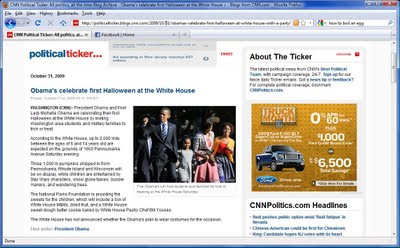 Click on image for larger version.
CNN story:
Update: CNN has corrected the error. Perhaps not coincidentally, my web stats counter shows a visitor from the CNN Political Ticker blog admin account this afternoon.
 Click on image for larger version.
CNN story:
Obama's (sic) celebrate first Halloween at the White House
Apparently even headline writers at CNN don't realize that plural words don't use apostrophes before the S. Or as they might have written, "plural's don't use apostrophe's before the S."Update: CNN has corrected the error. Perhaps not coincidentally, my web stats counter shows a visitor from the CNN Political Ticker blog admin account this afternoon.
Friday, October 30, 2009
Radio Host Sileo Suspended -- For Being Wrong or for Biting Feeding Hand?
A Tampa radio station suspended its morning host for reporting a story about the owners of the Tampa Bay Buccaneers. WDAE-AM host Dan Sileo claimed that the Glazer family, which owns the Bucs, had lost $475-million in Bernard Madoff's ponzi scheme and might be forced to sell the team because of it.
 Click Image for Larger Version
And what say would the team have over what a radio station reports? WDAE is the flagship station for the Buccaneer Radio Network, a designation that WDAE's owner, Clearchannel, wrested away from WQYK back when the Bucs used to win games and their radio contract was a coveted property.
Was Sileo suspended because of his story's subject or because he apparently got its facts wrong? Believe it or not, screwing up a story is not illegal, provided that you report it in good faith believing it to be true. Dan Sileo is not a reporter, he's a talk radio host -- and not a very good one of those for my money -- but he enjoys the same protections a reporter does.
But I wonder: Could the Glazers have dictated how "Mr. Sileo will be dealt with" if WDAE were not the team's radio broadcast partner. Would Clearchannel have issued such a public retraction and suspended Sileo so quickly?
Listen to it here: WDAE-620 AM audio clip, posted by the St. Petersburg Times on its website when it reported Sileo's suspension.
The team issued a statement flatly denying all of Sileo's claims, including that the team was for sale and that the Glazers had invested with Madoff. "The report is baseless, irresponsible and slanderous," the statement said. "This type of behavior by Mr. Sileo and his company Clear Channel will be dealt with in the appropriate manner."
Sure enough, later yesterday, the station issued a retraction of Sileo's story still prominently displayed on the homepage of its website today.
 Click Image for Larger Version
And what say would the team have over what a radio station reports? WDAE is the flagship station for the Buccaneer Radio Network, a designation that WDAE's owner, Clearchannel, wrested away from WQYK back when the Bucs used to win games and their radio contract was a coveted property.
Was Sileo suspended because of his story's subject or because he apparently got its facts wrong? Believe it or not, screwing up a story is not illegal, provided that you report it in good faith believing it to be true. Dan Sileo is not a reporter, he's a talk radio host -- and not a very good one of those for my money -- but he enjoys the same protections a reporter does.
But I wonder: Could the Glazers have dictated how "Mr. Sileo will be dealt with" if WDAE were not the team's radio broadcast partner. Would Clearchannel have issued such a public retraction and suspended Sileo so quickly?
Thursday, October 29, 2009
Titillation for Ratings?
Ah, ratings sweeps periods. Those times when stations pull out all the stops to lure viewers. Or in this case, take off all the tops. WJLA-TV, the ABC affiliate in Washington, D.C., offers this special report demonstrating with graphic detail how a woman does a breast self exam, nipples and all.
Remember, you are not to watch the video embedded below for any reasons of prurient interest. You are to watch only out of your concern for saving lives from a horrible disease. Or to judge the journalistic merits of such a story.
Unlike me.
Here is the link to the text version of the story, which I am certain you will want to read to get more details.
The video is informative, without a doubt, probably even to people who have breasts. I am equally sure that public education was not the primary reason for doing that story.
Do noble ends justify less altruistic motives?
Remember, you are not to watch the video embedded below for any reasons of prurient interest. You are to watch only out of your concern for saving lives from a horrible disease. Or to judge the journalistic merits of such a story.
Unlike me.
Here is the link to the text version of the story, which I am certain you will want to read to get more details.
The video is informative, without a doubt, probably even to people who have breasts. I am equally sure that public education was not the primary reason for doing that story.
Do noble ends justify less altruistic motives?
Sunday, September 27, 2009
Twitter Gag
Media outlets often decry the lack of transparency in the organizations they cover. This is ironic since they seem not to grasp the concept.
 An editor at the Washington Post expressed personal opinions on his Twitter feed and the paper responded by closing the curtain on staffers' personal expressions on social media.
This post on PaidContent.org includes the complete text of the new policy, which the Post did not reveal itself.
In the Post's view, the problem is that Raju Narisetti, one of its two managing editors, tweeted, “We can incur all sorts of federal deficits for wars and what not but we have to promise not to increase it by $1 for healthcare reform? Sad.”
And: “Sen Byrd (91) in hospital after he falls from ‘standing up too quickly.” How about term limits. Or retirement age. Or commonsense to prevail.”
That's not the problem. The problem is that the Post apparently believes that keeping its employees' biases secret from the public is how to maintain a pretense of objectivity in its reporting.
All journalists worth the the title try to keep their opinions out of their stories. But one's worldview can't help but shape their vision of stories.
Revealing reporters' and editors' personal views better informs readers about stories. Few even reasonably observant people still believe that any but the most basic who/what/where stories are free of bias.
It's not a conspiracy to spin stories a certain way. It's that pure objectivity is impossible because, like beauty, objectivity is in the eye of the beholder.
The problem, and this may be the fear of many news outlets, would be if openness about personal opinion revealed that an overwhelming percentage of the staff shared the same biases. But that, too, is something readers should know.
Lift the veil. Open the curtain. Let in the light. Transparency is good.
This post on PaidContent.org includes the complete text of the new policy, which the Post did not reveal itself.
In the Post's view, the problem is that Raju Narisetti, one of its two managing editors, tweeted, “We can incur all sorts of federal deficits for wars and what not but we have to promise not to increase it by $1 for healthcare reform? Sad.”
And: “Sen Byrd (91) in hospital after he falls from ‘standing up too quickly.” How about term limits. Or retirement age. Or commonsense to prevail.”
That's not the problem. The problem is that the Post apparently believes that keeping its employees' biases secret from the public is how to maintain a pretense of objectivity in its reporting.
All journalists worth the the title try to keep their opinions out of their stories. But one's worldview can't help but shape their vision of stories.
Revealing reporters' and editors' personal views better informs readers about stories. Few even reasonably observant people still believe that any but the most basic who/what/where stories are free of bias.
It's not a conspiracy to spin stories a certain way. It's that pure objectivity is impossible because, like beauty, objectivity is in the eye of the beholder.
The problem, and this may be the fear of many news outlets, would be if openness about personal opinion revealed that an overwhelming percentage of the staff shared the same biases. But that, too, is something readers should know.
Lift the veil. Open the curtain. Let in the light. Transparency is good.
Sunday, September 06, 2009
Dear St. Petersburg Times
I applaud you for offering video coverage of high school football largely abandoned by the local television stations, but your efforts demonstrate why you can't just hand a microphone to anyone and expect professional results.
To get to the first game story in the example below, a viewer must suffer through two bits of on-camera awkwardness, the first of which even a cameo by the classy Tony Dungy can't rescue.
I hope other viewers got through more of that than I did. I know times are tough and you don't have the budget to hire professionals to tell video stories. So I offer some consulting tips to your reporters free of charge.
I'm sure more thoughts would have occurred to me had I been able to watch more but to share them I'd have to charge a consulting fee. You don't want to pay consultants.
That would make you just like TV stations, who have to pay people to tell their reporters how to do their jobs because they are too cheap to hire professionals who already know.
If you get nothing else out of this, please, please remember the crotch at the camera thing.
To get to the first game story in the example below, a viewer must suffer through two bits of on-camera awkwardness, the first of which even a cameo by the classy Tony Dungy can't rescue.
I hope other viewers got through more of that than I did. I know times are tough and you don't have the budget to hire professionals to tell video stories. So I offer some consulting tips to your reporters free of charge.
- Microphones may seem too sophisticated for a novice to operate but they are not. Simply point them toward the person speaking. I did not realize that this took practice to master but you have not yet perfected this skill.
- If you are not funny, do not try to be funny. Oh, people will laugh. But for the wrong reasons.
- If you are not funny, do not ask celebrities willing to do cameos to play along with your bits. Viewers will feel embarrassed for the guest and antipathy toward you.
- If you are not funny, do not ask the athletes you are covering to play along with your bits. Viewers will feel embarrassed for the athletes and antipathy toward you.*
- If you are not funny — and even if you are, which is not an immediate danger here — keep the bits short. They won't be any less painful to watch but at least the discomfort will end sooner.
- Don't mumble your narration over the highlights. I understand that the whole video thing was probably not your idea and you're only doing it because your editor told you that there are a hundred hungry journalists waiting in line for your job if you don't want it and that the effort you put into writing and recording the narration is whatever you have left after writing the version of the game story that will appear in the paper. But it doesn't have to sound like that.
- *Also, there are no circumstances under which you should do a bit in which your legs are spread and your crotch is pointed at the camera.
I'm sure more thoughts would have occurred to me had I been able to watch more but to share them I'd have to charge a consulting fee. You don't want to pay consultants.
That would make you just like TV stations, who have to pay people to tell their reporters how to do their jobs because they are too cheap to hire professionals who already know.
If you get nothing else out of this, please, please remember the crotch at the camera thing.
Friday, July 17, 2009
Secret Outback Blacklists
I'm going to have to resist using exclamation points after every sentence as I write this. It really is that outrageous.
I stumbled across an entry in a Canadian law blog that may be the next site added to the blacklist in question.
The Australian government -- yes, Australia, not China or Myanmar but Australia! -- plans to ban more than 1,300 websites. More than that, it wants to prohibit even linking to them.
"That’s not just like banning books," writes blog author Ezra Levant. "It’s like banning books, and banning saying the banned book’s title."
Right now it's only a pilot program with cooperation by Internet service providers. But if this voluntary test run works, it could become law, for which violators would risk a fine of $11,000. Per day!
That's not the best part. In a Catch-22 that would make Joseph Heller proud, and maybe Adolph Hitler too, the Aussie authorities won't reveal what sites are on the blacklist. That would, of course, be against the law. So you can't know that you've broken the law until you're arrested for doing it.
I'm guessing most of the sites are NSFW and many may be illegal. But how would you know? The blacklist was compiled in secret. Unless it leaked, which it has. The website Wikileaks.org published the entire list.
And I was right. There are a lot of sites whose very names will turn your stomach with disgust. Then there are sites like cdpoker.com and fulltiltpoker.com, which are online poker sites. Not my thing but worth banning? Oops. Linking to those sites myself might have earned me place on the blacklist as well as an $11,000 fine. Today.
If I lived in some backwoods bush like Australia, that is.
The Sydney Morning Herald, which apparently has more time to scan the list -- and less fear of what its links might lead to -- than I do, found a dentist's website. The article points out the problem when perfectly innocuous sites make the blacklist: Their owners get lumped in with the child pornographers and other criminals because some bureaucrat somewhere, who doesn't have to answer for his actions, added them to the list, perhaps accidentally.
Incredible. If this actually becomes law you wonder:
Can the Sydney Witch Trials be far behind?
I stumbled across an entry in a Canadian law blog that may be the next site added to the blacklist in question.
The Australian government -- yes, Australia, not China or Myanmar but Australia! -- plans to ban more than 1,300 websites. More than that, it wants to prohibit even linking to them.
"That’s not just like banning books," writes blog author Ezra Levant. "It’s like banning books, and banning saying the banned book’s title."
Right now it's only a pilot program with cooperation by Internet service providers. But if this voluntary test run works, it could become law, for which violators would risk a fine of $11,000. Per day!
That's not the best part. In a Catch-22 that would make Joseph Heller proud, and maybe Adolph Hitler too, the Aussie authorities won't reveal what sites are on the blacklist. That would, of course, be against the law. So you can't know that you've broken the law until you're arrested for doing it.
I'm guessing most of the sites are NSFW and many may be illegal. But how would you know? The blacklist was compiled in secret. Unless it leaked, which it has. The website Wikileaks.org published the entire list.
And I was right. There are a lot of sites whose very names will turn your stomach with disgust. Then there are sites like cdpoker.com and fulltiltpoker.com, which are online poker sites. Not my thing but worth banning? Oops. Linking to those sites myself might have earned me place on the blacklist as well as an $11,000 fine. Today.
If I lived in some backwoods bush like Australia, that is.
The Sydney Morning Herald, which apparently has more time to scan the list -- and less fear of what its links might lead to -- than I do, found a dentist's website. The article points out the problem when perfectly innocuous sites make the blacklist: Their owners get lumped in with the child pornographers and other criminals because some bureaucrat somewhere, who doesn't have to answer for his actions, added them to the list, perhaps accidentally.
Incredible. If this actually becomes law you wonder:
Can the Sydney Witch Trials be far behind?
Thursday, July 16, 2009
Too Funny!
Does the headline and verbiage in the screen capture below look familiar? (Click on it to see it normal size.) If not, scroll down a few entries on this blog.

I'm going to let them figure this one out on their own.
See the copy on their website here.

I'm going to let them figure this one out on their own.
See the copy on their website here.
Subscribe to:
Posts (Atom)